Event summary: Assistive technology and gender equality for advancing the leadership of women with disabilities
A featured side event at the 19th Conference of States Parties (COSP19) to the CRPD
Date: Thursday, 11 June 2026
Hosted by: Global Forum on the Leadership of Women with Disabilities (GFLWD)
Partners: ATscale, UNFPA, Sighsavers, UNITAR, and the Special Talent Exchange Program (STEP)
To mark the 20th anniversary of the Convention on the Rights of Persons with Disabilities (CRPD), women leaders with disabilities, experts, and g advocates convened in New York for a vital side event. Focused on CRPD Article 16 (freedom from exploitation, violence, and abuse), the session explored how expanding equitable access to Assistive Technology (AT) can dismantle systemic barriers, prevent technology-facilitated gender-based violence (TFGBV), and accelerate the leadership of women and girls with disabilities.
While emerging technologies offer unprecedented paths to independence, they also present sophisticated risks of online abuse, harassment, and coercive surveillance. The event’s overarching consensus was clear: digital inclusion is impossible without digital safety, and accessibility without safety is not true inclusion.
Welcome setting the stage
Cara Yar Khan | Event Moderator
Opening the session, seasoned moderator and advocate Cara Yar Khan framed the discussion around both the historic promise of the CRPD and the critical digital gaps that remain today.
"As we mark the 20th anniversary of the CRPD, we are looking at both progress made and the critical gaps that remain. Article 16 guarantees freedom from exploitation, violence, and abuse, yet women and girls with disabilities continue to face disproportionately high rates of violence—often compounded today by digital spaces and technology-facilitated abuse."
Keynote address
H.E. Ambassador Luis Gallegos | President of the Commission of UNITAR, Ecuador
Ambassador Gallegos, who presided over the original UNCRPD negotiations in the early 2000s, shared historical reflections and issued a direct call to member states to move from paper commitments to real, enforceable policy.
"The right to freedom of exploitation or violence or abuse—it's not enough to declare that right on paper. We are obliged to make it in real practice. The CRPD is an instrument of public policy, signed by the majority of countries, and therefore it is an obligation of those countries to comply with it."
Technical Session: Rights, safety, and evidence
The technical segment featured presentations exploring the systemic intersections of human rights, assistive technology, digital safety, and global data.
1. Everyone’s right to access assistive technology
Gertrude Oforiwa Fefoame | Global Advocacy Manager for Social Inclusion, Sightsavers
Fefoame emphasized that AT is not merely a medical or functional commodity, but a non-negotiable prerequisite for human dignity, particularly for marginalized women in developing countries.
"Access to and use of assistive technology is essential for the enjoyment of other rights. For women and girls with disabilities, particularly from developing countries... it forms the bedrock of our survival, our rights, our progress, and our dignity."
2. Bridging tech innovation, safety, and policy
Cecile Mazzacurati | Programme Advisor on Gender, UNFPA
Cecile highlighted UNFPA's efforts to combat the rising crisis of TFGBV through "Safety by Design" principles, ensuring that new tech tools do not become pathways for abusers. She also showed the UNFPA film, Technology-facilitated gender-based violence against women and girls with disabilities.
"Human rights must be protected online, just as they must be protected offline. We cannot achieve digital and technological inclusion without digital safety... By reducing dependency and giving women with sensory, physical, or cognitive disabilities the power to navigate the world safely, assistive technology serves as a critical protective shield."
3. Evidence-based action: Unlocking HER Potential
Ceridwen Johnson | ATscale
Ceridwen presented the findings of the joint UN Women and ATscale policy brief, exposing the stark, gendered divide in AT access and highlighting how systemic inequality is reinforced when technology remains inaccessible.
"Assistive technology can mean the difference between being able to study, to work, to lead, to care for others, to participate in public life, or being excluded from all of it. Unlocking a woman's potential begins with ensuring that she has the tools to lead, and she has the tools to thrive."
Panel discussion: Bridging gaps through assistive technology and legal frameworks.
The second half of the event brought together women advocates to discuss how to turn high-level international treaties into local, grass-roots realities.
Claire Gibellini | Chair, National Disability Research Partnership
Claire called out the siloed operations of international institutions, advocating for a coordinated approach that integrates tech mandates with gender protection frameworks.
"Our digital transformation work, our GBV prevention work, and our disability inclusion work too often run on parallel tracks that do not intersect. We need to hardwire coordination across mandates... If we can get that right, then assistive tech and GBV prevention will move from being those 'add-ons' and become core features of how programming is conceived, funded, and delivered."
Sara Kamau | Chair, Commonwealth Disabled People's Forum
Representing a vast disability network spanning the Global South, Sara Kamau highlighted the profound systemic, financial, and infrastructural barriers faced by rural women with disabilities, urging direct, un-bureaucratic funding for local organizations.
"We need to ensure that we co-create technology-based protection tools with grassroots organizations, not just consulting them, but involving them in the things we are doing for them—because there is 'nothing without us."
Bonnie Brayton | Chief Executive Officer, DAWN Canada
Bonnie applied an intersectional feminist lens to the discussion, warning of the potential dangers of rapidly deploying artificial intelligence (AI) and adaptive software without robust accountability checks.
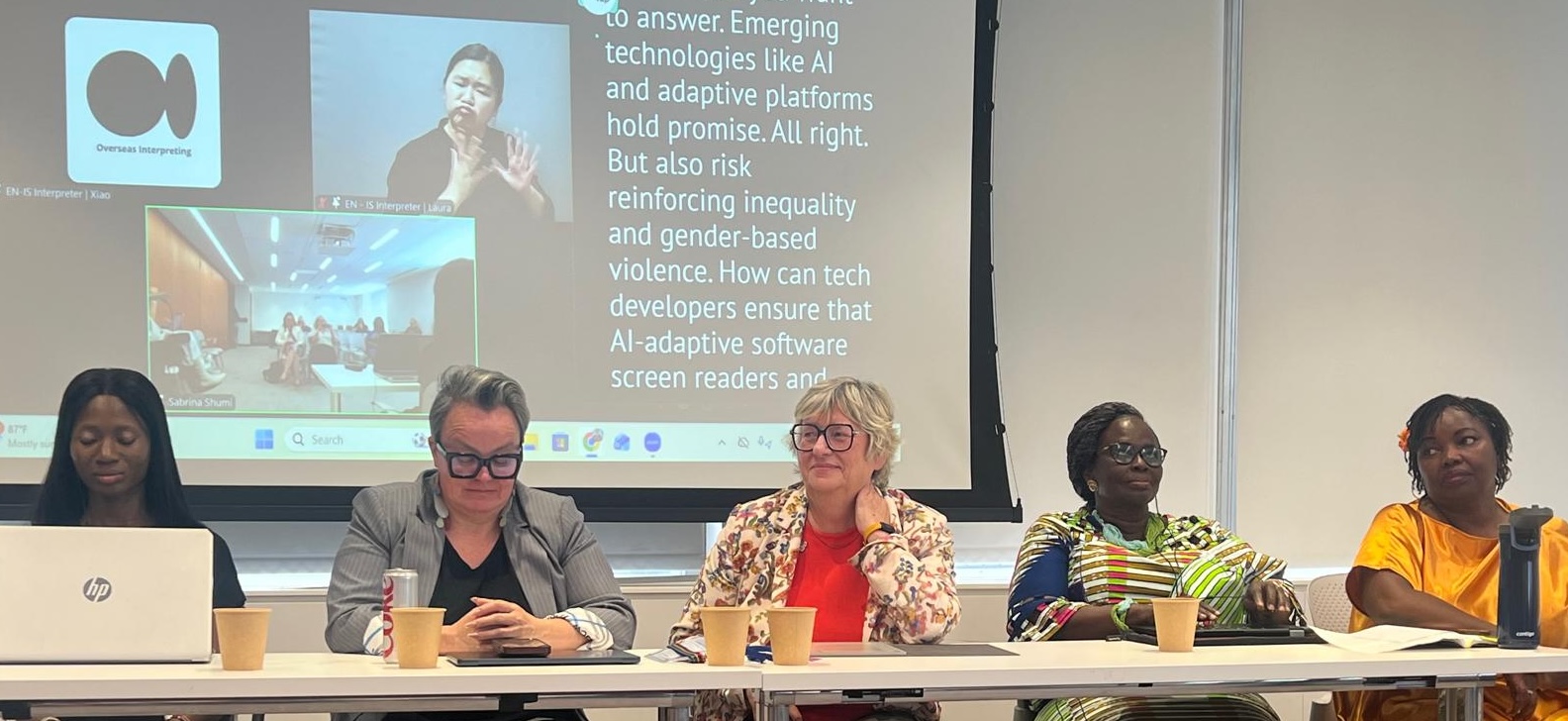
"Accessibility without safety is not inclusion, and innovation without accountability risks reinforcing inequality. Emerging technologies like AI, adaptive platforms, and assistive technology are often framed as neutral... but they can expose individuals to surveillance and coercive control when safety is not intentionally built into their design."
Esther Nagetey | Youth and Gender Advisor, International Disability Alliance
Closing out the panel, Esther shared the immediate, lived realities of young women with disabilities navigating our digitized world.
"Assistive technology is not a luxury. It is not only a device or a technical solution. For many of us, assistive technology is the difference between exclusion and participation, silence and voice, dependence and independence, and sometimes even risk and safety. The question is not only whether technology exists; the question is who can access it, who controls it, who is protected by it, and whose safety and dignity were considered when it was designed."
Key recommendations
Based on the expert discussions, the event organizers and partners call on Member States, UN agencies, tech developers, and civil society to take immediate action on the following fronts:
Mainstream gender-Transformative AT: Ensure national health, education, and social protection budgets explicitly allocate resources for gender-responsive, affordable assistive technology.
Mandate safety by design: Tech companies and developers must involve women with disabilities at the inception phase of product development to build safeguards against abuser surveillance, TFGBV, and data exploitation.
Bridge institutional silos: Drive cross-agency coordination to hardwire digital accessibility into humanitarian response plans and gender-based violence prevention frameworks.
Fund and empower grassroots OPDs: Directly fund local, youth-led, and women-led Organizations of Persons with Disabilities to co-create protective, context-specific digital tools.
🔗 Get Involved
- Read the policy brief: Learn more about how you can support this critical work by accessing the Unlocking HER Potential
- Learn more about Technology-facilitated gender-based violence against women and girls with disabilities
- Join the Conversation: Use the hashtags #LETSMAKEITOURS #CRPD20 #GenderEquality #WomenLeaders on social media to share your reflections.