A national commitment: Azerbaijan's legislative push for a more inclusive future
For our world to be truly inclusive, assistive technology can act as a crucial bridge, helping people live independently and participate fully in society. However, for hundreds of millions of people – especially in low- and middle-income countries – access to these essential tools and services remains a significant obstacle.
Azerbaijan is committed to preventing anyone from being left behind. Through comprehensive legislative reform, increased investment, and a dedication to user involvement, the country is strengthening its assistive technology ecosystem and creating a more inclusive future for its people.
ATscale is supporting WHO Regional Office for Europe and WHO Azerbaijan in integrating assistive technology into health and social protection systems, using a systems-strengthening approach that includes targeted interventions in policy, financing, workforce development, service delivery and data systems.
Legislative reform: a cornerstone of change
In recent years, the Government of Azerbaijan has shown a strong commitment to assistive technology by putting around 20 legislative acts in place to align its national laws with the United Nations Convention on the Rights of Persons with Disabilities (CRPD). These reforms aim to promote social inclusion, enhance infrastructure accessibility and strengthen rehabilitation services, including assistive technology provision and the creation of a national register of persons with disabilities.
The update of Azerbaijan’s national assistive products list (APL), known locally as the List of Means of Rehabilitation, in 2024, was a pivotal moment. Following extensive consensus-building, the Cabinet of Ministers adopted Decree #500, broadening the list from 57 to a comprehensive 130 items. This expansion, supported by ATscale and WHO Euro, aligned the national APL more closely with WHO’s priority assistive products and classification standards. It will help ensure more equitable access to essential assistive technology for those who need it.
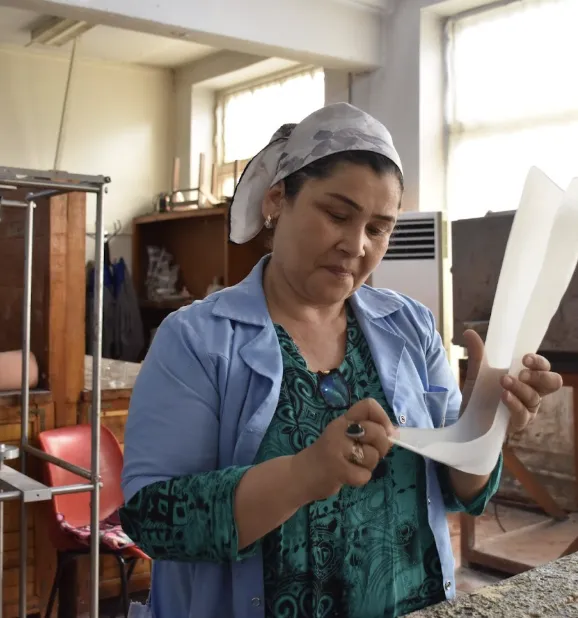
“Until recently, if someone needed an assistive product, they had to buy it themselves - if they could afford it,” explains Mr Asif Majidov, Director of the Prosthesis and Orthosis Production and Rehabilitation Centre (POIRM), a national hub for state-funded assistive products. “These are not one-time purchases. Many devices need regular replacement or maintenance. That’s a huge financial burden.”
The impact of this change is significant. “When a person gets what they need without facing financial hardship, it not only enhances their quality of life but also brings satisfaction and peace of mind. It tells them, ‘you are not forgotten’,” Mr Majidov adds. He recalls the heartbreak of having to tell patients, “It’s not on the list. We can’t provide it”. Experiences like these triggered advocacy efforts, leading to the expansion of the APL. “It wasn’t just a bureaucratic change,” he states proudly, “it was a message to our patients that their needs are being recognized. And for us, as service providers, it opened the door to genuine, personalized care.”
Investing in a more inclusive future
Beyond legislation, Azerbaijan is strengthening its assistive technology workforce and increasing funding. The Ministry of Labour and Social Protection of the Population has shown commitment, raising the national budget for assistive technology, expanding the variety of government-supported products, and broadening eligibility criteria. The assistive technology budget grew from 13 million AZN in 2022 (about 7.6 million US$) to an estimated 17 million AZN (around 10 million US$) in 2024. Simultaneously, the government covers all of the initial costs for wheelchairs, eyeglasses and hearing aids for registered persons with disabilities. WHO is actively championing a more comprehensive and inclusive approach to assistive technology funding, extending beyond those with formal disability certification to include older adults and people with functional limitations.
Quality and user involvement
Mr Davud Rahimli, president of the Azerbaijan Union of Disabled People Organizations (UDPO) and a daily user of assistive technology, highlights the vital importance of quality and user participation. “Standards are lifesaving. Poor quality can be dangerous. Products must be easy to use, safe and reliable,” he states. His focus on quality is globally relevant, as poor quality, improper fitting and lack of follow-up lead to high rates of assistive product abandonment, resource wastage, increased health risks and individuals being left without the support they need. He strongly believes that “people with disabilities understand these products better than anyone. We know what works and what doesn’t. We should be involved in the decision-making process, from design to distribution.” His message to policymakers is clear: “Most of us face financial hardship. Assistive products must be both affordable and easily accessible. We need to be recognized not just as users, but as experts in our own right.”
Knowledge exchange: a catalyst for improvement
Dr Matanat Afandiyeva, Director of the Scientific Research Institute of Medical Rehabilitation Medicine under the Ministry of Health of the Republic of Azerbaijan, highlights the transformative power of knowledge exchange. Reflecting on a sub-regional workshop on assistive product specifications and quality standards, organized by WHO and supported by ATscale, she says: “The workshop highlighted the importance of product quality in assistive technology – how essential it is for improving the lives of people in need of assistive technology and supporting their integration into society”. She adds, “My approach to evaluating and selecting assistive devices has changed. I now pay even closer attention to international quality standards and the functional needs of users”.
The road ahead: challenges and opportunities
Challenges persist in human resources, especially a significant shortage of qualified assistive technology and rehabilitation professionals, mainly in the public sector. Despite this, efforts are continuing to incorporate assistive technology into primary healthcare, with high-level dialogues and plans to train doctors and nurses using WHO’s Training in Assistive Products (TAP).
Dr Vugar Mammadov, Deputy Chair of the Board of the State Medical-Social Expertise and Rehabilitation Agency in Azerbaijan, whose role is to ensure that people who need assistive technology receive it, emphasizes the need for deep reforms and cross-sectoral coordination. Having worked in both medicine and law, he views disability not just as a health issue but also as a legal and human rights concern. He recalls the outdated APL with only 57 products, of which just 33 are truly rehabilitation devices, with almost nothing available for people with visual, hearing, communication, cognitive or mental health-related disabilities. He states that, “there is no national rehabilitation law in Azerbaijan. We must develop one, and it must enshrine access to assistive technology as a human right”.
Through ATscale, efforts are focused on strengthening the enabling environment, including policy reforms, and developing capacity within Azerbaijan’s assistive technology sector. By emphasizing collaboration, innovation and a user-centred approach, Azerbaijan aims to create a nation that leaves no one behind.