Navigating an inaccessible world: Why assistive technology is critical for inclusive education
By Pascal Bijleveld, CEO, ATscale, the Global Partnership for Assistive Technology, and Pia Rebello Britto, Global Director of Education, UNICEF
A hearing aid is more than a device — it is a bridge to understanding, dialogue, and belonging. In my political science studies, it lets me join debates with confidence. Assistive technology turns silence into speech, confusion into clarity, and distance into connection. It is not just an opportunity for me — it is for every learner navigating an inaccessible world.
— Young assistive technology user, Philippines
That quote is not a campaign line. It is testimony from a young person who had to teach herself to use a hearing aid, navigate classrooms without captioning, and explain their needs individually to every professor — because no institutional system existed to do it for her. That is the gap we are working to close. Not with more reports. With better policies, trained teachers, appropriate products, accountable procurement, and services that follow the learner rather than requiring the learner to chase the service.
The promise of inclusive education—a world where every child, regardless of disability, has the chance to learn and thrive—is one of our most urgent global commitments. Yet, for millions of children, this promise remains out of reach.
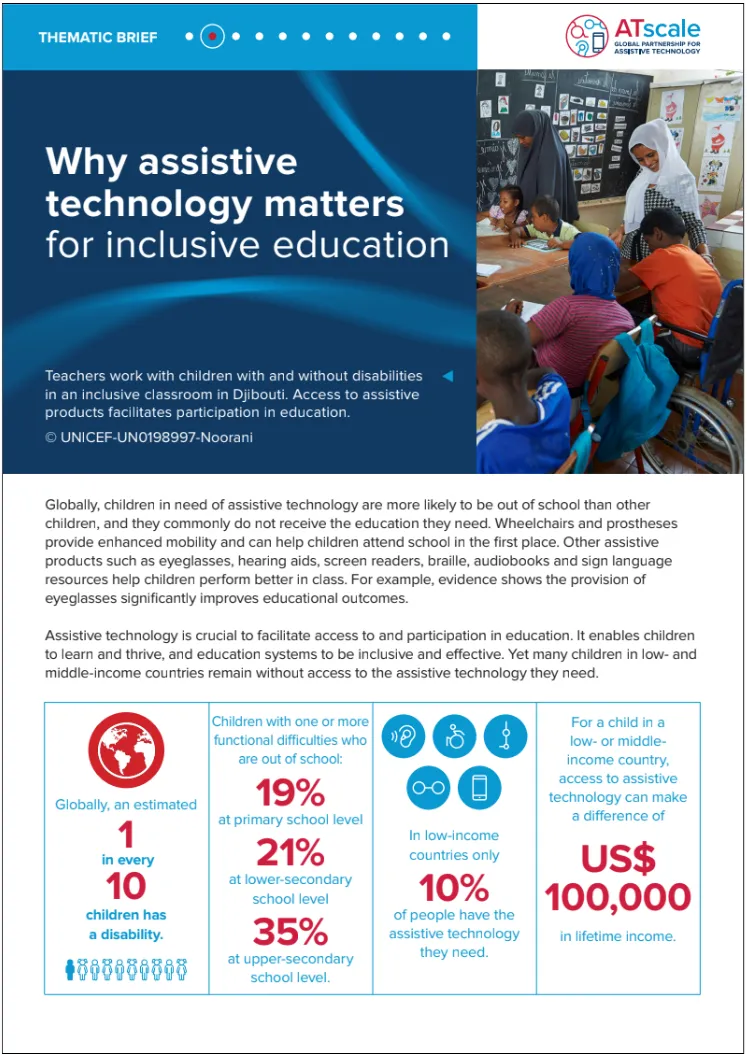
The evidence is compelling: in low- and middle-income countries, children with disabilities are almost 50 percent more likely than their peers never to have attended school. Even when enrolled, these learners often achieve lower literacy and numeracy outcomes and experience higher dropout rates. This exclusion is not an accident; it is the result of a system that fails to provide the essential tools children need to participate in learning.
When a child can access a hearing aid, a screen reader, a wheelchair, or a communication device, it doesn’t just change how they navigate the world today — it can transform their future. For example, providing glasses to children with visual impairment leads to measurable improvements in academic performance and school retention, while early access to hearing aids helps close gaps in listening and learning between learners with and without hearing impairments. Assistive technology forms a bridge between a child’s potential and their reality.
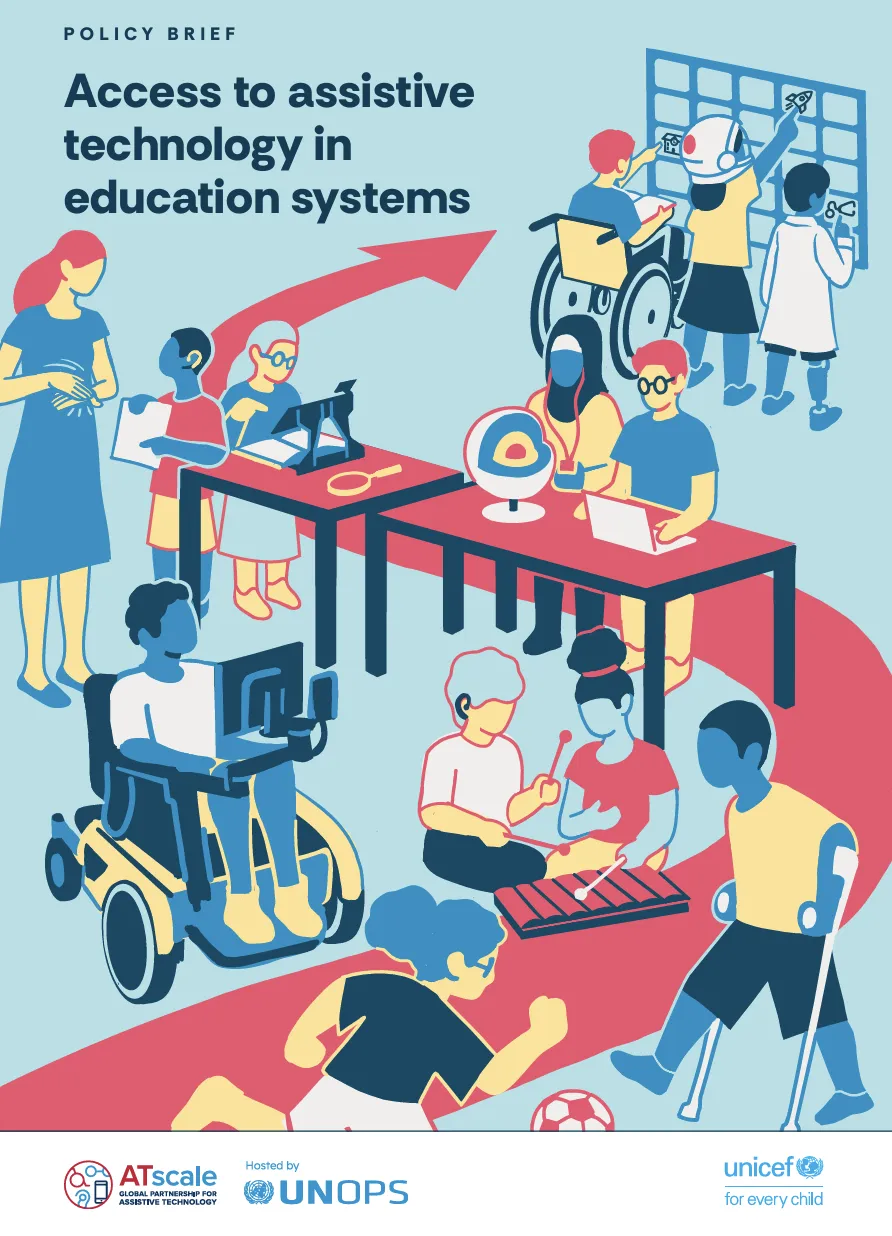
Yet access remains out of reach for most. The joint ATScale-UNICEF policy brief on Access to Assistive Technology in Education Systems confirms that barriers follow a consistent pattern across countries, captured in the 5Ps framework: people (families) face high costs, scarce information, and stigma — particularly for girls; policy is fragmented across health, education, and social protection, with unclear mandates and insufficient budget allocations; products, often procured for lowest cost, are often poorly fitted to children and abandoned when they fail; personnel — the teachers, therapists, and community workers who make AT usable — are usually undertrained and undersupplied, and provision remains a one-off transaction rather than a continuous service: assessment, fitting, training, maintenance, and follow-up are the exception, not the rule. These five dimensions are interdependent. Addressing one without the others produces neither scale nor sustainability.
The conclusion is consistent across every country context: no single fix works. A child who receives a device but no training, a teacher who has no guidance, a government that has policy but no budget — these are not isolated failures. They are symptoms of a system that was never designed to include every learner. That has to change.
Our work is already showing what is possible with the right investment. ATscale’s Unlock Healthy Learning Programme in the Pacific Islands — supported by the Australian Government — ensures that all screened school-aged children receive the eyeglasses, hearing aids, and mobility devices they need to learn. UNICEF’s work with the Government of Malawi to strengthen inclusive education systems and provision of assistive technology has enabled 215,224 children with disabilities, including 104,206 girls, to access primary education, resulting in an 11 per cent increase in enrolment of children with disabilities since 2023.
These results are not incidental. They are what happens when assistive technology is embedded in systems rather than appended to them. For ministries of education, this means intentionally including assistive technology into sector planning and budgeting: developing approved education-specific product lists and procurement processes; budgeting not only for devices, but also for assessment, fitting, teacher training, maintenance, repair and follow-up; and using education data systems to track need, provision, and use. It also requires clear links with health and social protection systems for products such as hearing aids, spectacles and mobility devices, so that children receive the support they need without families having to navigate disconnected systems on their own. Critically, this means shifting from donor-supported provision toward predictable domestic resource allocation, so that assistive technology is planned, financed and sustained through education sector budgets rather than treated as a temporary add-on.
Achieving this scale requires coordinated action. The policy brief offers a blueprint for stakeholders to prioritize investments and interventions that foster ecosystem-wide change:
- For donors and development partners:
- Sustainable financing: Invest in long-term, sustainable financing mechanisms for assistive technology, integrated into national health and education budgets.
- Capacity building: Fund comprehensive training for teachers, school administrators, and rehabilitation professionals.
- Evidence and innovation: Support research, data system strengthening, and the piloting of innovative solutions like the use of smartphones as assistive technology and text-to-speech technology.
2. For policymakers and governments:
- National vision: Define a national vision for assistive technology, supported by legislation and cross-sectoral coordination between health, education, and social protection.
- System integration: Integrate assistive technology into education policies, budgets, teacher training curricula, and school-based support services.
- Data and monitoring: Strengthen data systems to accurately monitor access, use, and educational outcomes for children who need assistive technology.
3. For civil society and communities
- Advocacy and awareness: Lead the charge in raising public awareness, challenging stigma, and advocating for full inclusion.
- User-centered solutions: Ensure that all initiatives are co-designed with and responsive to the needs and experiences of users and their families.
Assistive technology should not be a luxury or an afterthought; it is one of the most powerful and critical enablers of inclusive education. Without it, inclusion is impossible for many children the education system is supposed to serve. Today, on the World Day for Assistive Technology, we commit to treating it that way — and to holding ourselves, and the systems we influence, accountable for doing the same.